
Program Alignment Process
This process establishes a standardized approach for aligning technical education programs across Utah System of Higher Education institutions with a technical college role. It ensures programs share common titles, course structures, learning objectives, and industry-aligned outcomes so students gain consistent, workforce-ready skills regardless of where they enroll.
Alignment begins with faculty and program leaders reviewing curriculum, credentials, and industry standards. They collaborate with chief instructional officers and alignment committees to compare programs across institutions. Recommendations for updates—such as changes to program names, course sequences, or learning outcomes—are developed collectively and submitted through a defined approval workflow that includes institutional leadership and the Commissioner’s office. The process includes regular review, documentation, and cross-institution coordination to ensure consistency, transparency, and responsiveness to workforce needs while maintaining compliance with system policies.
When faculty identify the need for a new aligned program based on workforce demand or gaps in existing offerings, campuses develop a proposed curriculum with defined outcomes, course structures, and credentials that fit alignment expectations. That proposal is then taken to an alignment committee or peer group composed of representatives from other institutions, where it’s compared with similar programs, or used to establish a new standard if none exists.
Once there’s agreement at that level, the proposal moves up through institutional leadership, like chief instructional officers, for broader academic and operational review. After that, it goes to the Commissioner’s office, where it’s evaluated for system alignment, policy compliance, and overall need. After passing through these stages, the program can be approved by the Utah Board of Higher Education and added to the program bank for campuses to begin implementation.
Once a proposal is drafted, Chief Instructional Officers review and vote on program proposals, representing institutional and stakeholder interests. Their review helps ensure the program is viable, regionally responsive, and aligned with educational goals.
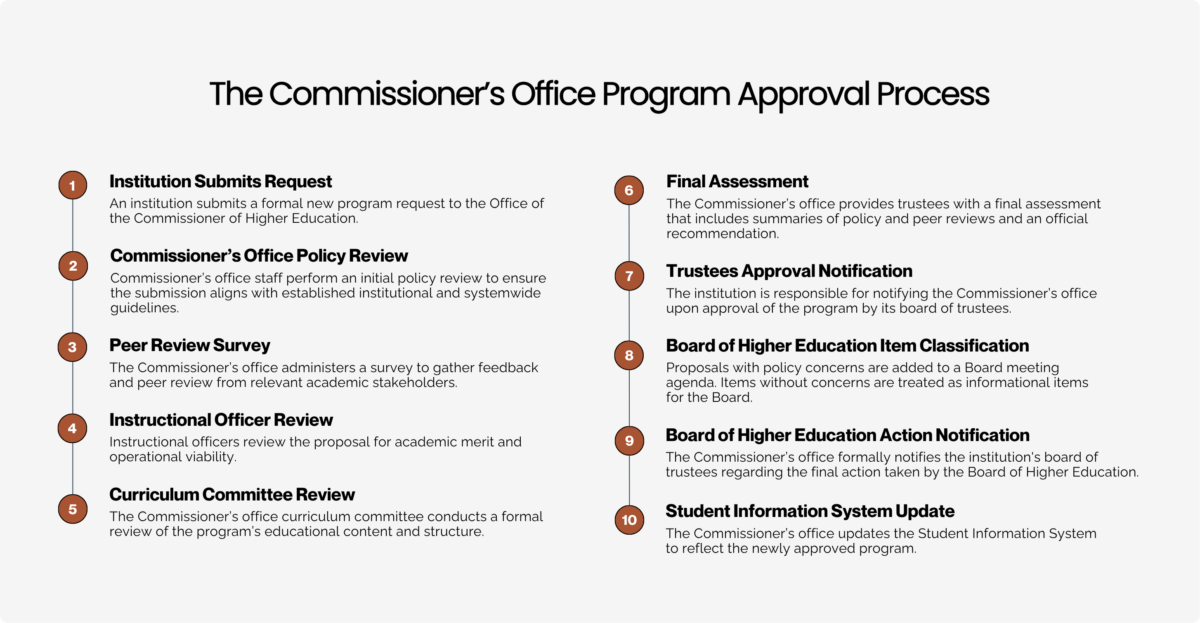
The Commissioner’s Office Program Approval Process
- Institution Submits Request
An institution submits a formal new program request to the Office of the Commissioner of Higher Education. - Commissioner’s Office Policy Review
Commissioner’s office staff perform an initial policy review to ensure the submission aligns with established institutional and systemwide guidelines. - Peer Review Survey
The Commissioner’s office administers a survey to gather feedback and peer review from relevant academic stakeholders. - Instructional Officer Review
Instructional officers review the proposal for academic merit and operational viability. - Curriculum Committee Review
The Commissioner’s office curriculum committee conducts a formal review of the program’s educational content and structure. - Final Assessment
The Commissioner’s office provides trustees with a final assessment that includes summaries of policy and peer reviews and an official recommendation. - Trustees Approval Notification
The institution is responsible for notifying the Commissioner’s office upon approval of the program by its board of trustees. - Board of Higher Education Item Classification
Proposals with policy concerns are added to a Board meeting agenda. Items without concerns are treated as informational items for the Board. - Board of Higher Education Action Notification
The Commissioner’s office formally notifies the institution’s board of trustees regarding the final action taken by the Board of Higher Education. - Student Information System update
The Commissioner’s office updates the Student Information System to reflect the newly approved program.
The Commissioner’s Office then evaluates the proposal through the USHE Review Committee. This includes a review by the Chief Economist to confirm alignment with broad occupational areas requiring more than a high school diploma but less than a degree, and a compliance review to verify that the proposal meets all statutory and policy requirements.
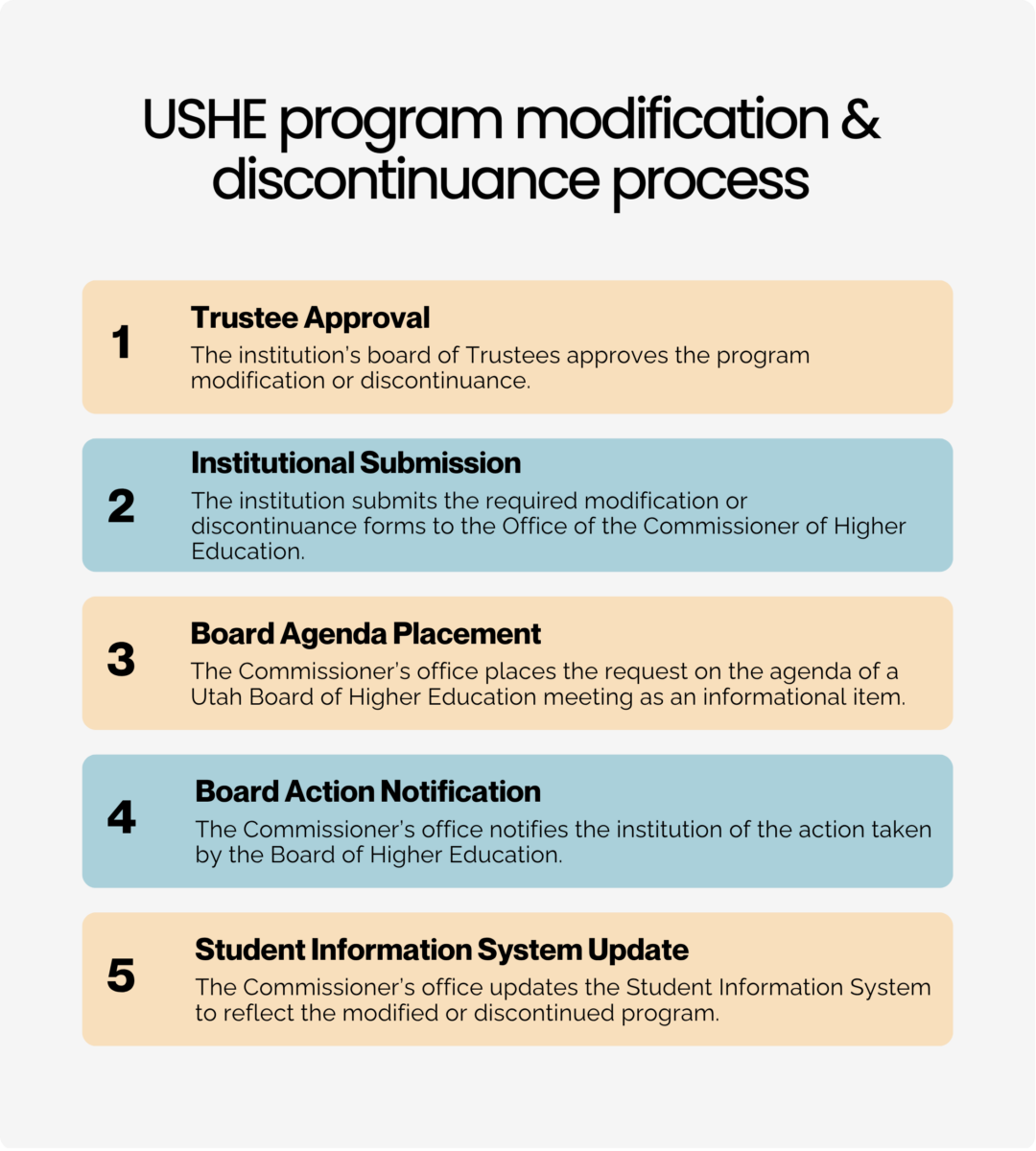
USHE program modification & discontinuance process
- Trustee Approval
The institution’s board of Trustees approves the program modification or discontinuance. - Institutional Submission
The institution submits the required modification or discontinuance forms to the Office of the Commissioner of Higher Education. - Board Agenda Placement
The Commissioner’s office places the request on the agenda of a Utah Board of Higher Education meeting as an informational item. - Board Action Notification
The Commissioner’s office notifies the institution of the action taken by the Board of Higher Education. - Student Information System Update
The Commissioner’s office updates the Student Information System to reflect the modified or discontinued program.
Supplemental courses may be added to the foundational, Board-approved training plan in order to address specific needs of students and industry in your service area. These courses are not regulated by UBHE and therefore do not require Board approval. In order to request a supplemental course, simply fill out the Supplemental Course Request Form and OCHE staff will add it to the program’s training plan for your institution.